-
Your shopping cart is empty!

Your shopping cart is empty!
Traditional visual inspection misses an average of 2 defects per 20,000 components on a production line. For electronics and semiconductor manufacturers, those 2 units represent warranty claims, product recalls, and damaged customer relationships. AI vision systems with custom model training now close this gap automatically, without reliance on cloud infrastructure or specialist data science teams.
This article covers how a custom-trained AI vision system inspects cylindrical welded components in a production setting, the hardware and software architecture behind it, the three defect types it detects, and the on-site training workflow that makes it adaptable to any product.
Welding defects on small precision components are among the most difficult quality failures to catch consistently with the human eye. On a cylindrical component such as an automotive pressure sensor, the weld seam runs around the full circumference of the part. A pinhole defect measuring less than a millimetre in diameter can compromise the pressure seal entirely, causing field failure weeks or months after the product ships to the customer.
The challenge is threefold. First, the defects are visually subtle and require close inspection from multiple angles. Second, human inspectors working under production throughput pressure cannot maintain consistent attention across thousands of components per shift. Third, traditional rule-based vision systems are rigid. They are calibrated for a fixed defect profile and fail when lighting conditions change, components vary slightly in position, or new defect types emerge.
The result is a predictable failure mode. Most defects are caught. A small number are not. Those that are not caught reach the customer.
The following defect categories represent the primary failure modes in circumferential weld seams on small cylindrical components in electronics and semiconductor applications.
The weld bead did not complete the full joint around the circumference. A gap remains in the seam. This is a structural failure that compromises both mechanical strength and sealing integrity.
A micro void within the weld material. On pressure-bearing components, a pinhole allows fluid or gas migration through the seal. The AI detection system identified this defect at 0.82 confidence score in production testing.
The weld geometry is incorrect. Surface topology deviates from the acceptable profile. This indicates inconsistent energy delivery during the welding process and produces a structurally weak joint. Detected at 0.91 confidence score.
The system detects multiple defect types simultaneously in a single inspection pass. A component with both a pinhole and a poorly formed weld in adjacent zones of the same seam will flag both in the same image frame, each with its own bounding box and confidence score.
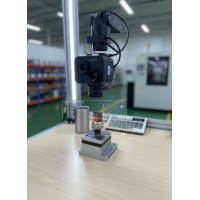
Accurate micro defect detection requires a camera capable of resolving fine surface detail at production speed. The system is deployed with the following primary camera configuration:
| Specification | Value |
|---|---|
| Model | HIKrobot MV-CS050-10UM/UC |
| Resolution | 5 Megapixel |
| Sensor | 2/3 inch CMOS |
| Interface | USB 3.0 |
| Scan type | Area Scan |
| Selection basis | Image clarity at defect scale and throughput speed. Camera selection is not fixed to a single brand. The specification is chosen based on the defect size and required inspection cycle time for each application. |
All AI inference and model training runs on a local industrial PC. No internet connection is required. No production images leave the facility. This is the primary deployment configuration:
| Component | Primary Configuration | Alternative Configuration |
|---|---|---|
| Platform | IPC-610 with AIMB-788G2 | Standard IPC chassis |
| Processor | Intel Core i5-12500 | Intel Core i7-6700 |
| Memory | 16 GB RAM | 16 GB RAM |
| Storage | SSD 128 GB system / HDD 1 TB data | SSD 128 GB system / HDD 1 TB data |
| GPU | NVIDIA GTX 1650 | NVIDIA GTX 1650 |
| Operating system | Windows 10 Enterprise | Windows 10 Enterprise |
| Network | Standard LAN | Dual LAN |
| Power supply | 300W | 300W |
GPU acceleration enables real-time inference during production inspection. The NVIDIA GTX 1650 provides sufficient compute capacity for the current model architecture without requiring data centre-class hardware.
A collaborative robot arm presents the component to the camera and rotates it through a full 360-degree inspection sequence. The system captures 9 images across all angles of the circumferential weld in approximately 3 seconds per component. This includes image capture, transfer, AI inference across all 9 frames, and defect flagging.
Off-the-shelf AI vision systems are trained on generic defect datasets. Their detection accuracy degrades when applied to a specific product with a specific surface finish, lighting condition, and defect morphology. Custom model training solves this directly.
The system includes a built-in training tool that allows production operators to build and update the detection model using their own components. The workflow requires no programming knowledge and no external data science support.
The system captures 9 images of actual production components from the real factory environment. These are not stock photographs or synthetic renders. The training data reflects the exact lighting, surface variation, and positional tolerances present on the production line.
The operator opens the annotation interface and draws bounding boxes around each defect visible in the captured images. Each box is labelled with the defect classification: incomplete weld, pinhole, poorly formed weld, or any custom category relevant to the product. This step defines the quality standard for the specific component being inspected.
The operator opens the training software and initiates training with a single click. The training process runs automatically on the local industrial PC using GPU acceleration. A terminal window shows training progress. No code is written. No cloud upload occurs. Training data remains on the production floor at all times.
When training completes, the updated model is deployed immediately. The system runs the same 9-image capture sequence on new components and applies the newly trained model. Detection accuracy improves because the model has learned from real defect examples specific to that product and production environment.
When a product changes or a new defect type is observed on the line, the operator repeats the annotation and training cycle independently. No service call is required. No external expertise is needed. The manufacturer owns and controls the detection model.
Production image data in electronics and semiconductor manufacturing is sensitive. Images of components can reveal design geometry, process parameters, and quality performance data that represents significant competitive and contractual risk if it leaves the facility.
This system processes all data locally. The industrial PC does not require an internet connection to perform inspection or training. No images, model weights, or inspection results are transmitted to external servers. This architecture is suitable for facilities operating under non-disclosure agreements with OEM customers, ISO 27001 information security management requirements, and IATF 16949 quality management frameworks that require data traceability and control.
Any manufacturing process that produces small components with circumferential or surface welds at high volume is a candidate for this inspection approach. The custom training capability means the system adapts to the specific defect profile of each product rather than requiring the product to conform to a pre-defined defect taxonomy.
The following questions are relevant for production managers evaluating AI vision systems for micro defect inspection:
| Parameter | Specification |
|---|---|
| Inspection cycle time | Approximately 3 seconds for 9 images across full 360-degree weld seam |
| Images per inspection cycle | 9 frames covering all circumferential angles |
| Defect types detected | Incomplete weld, pinhole, poorly formed weld, and custom categories via training |
| Simultaneous detection | Multiple defect types detected in a single image frame |
| Confidence scoring | Per-defect probability score displayed with each bounding box |
| Training requirement | No coding. No data science expertise. Operator-level training capability. |
| Data processing location | Fully local. No internet connection required. No cloud dependency. |
| Component handling | Collaborative robot arm for 360-degree presentation and rotation |
| Camera | 5 MP 2/3 inch CMOS USB 3.0 Area Scan (model selected per application requirements) |
| Processing hardware | Industrial PC with NVIDIA GTX 1650 GPU. Intel i5-12500 or i7-6700 processor. |
| Operating system | Windows 10 Enterprise |
| Typical defect detection performance | 2 defects detected per 20,000 components on electronics production line |
FA Controls Sdn Bhd has been providing industrial automation and AI vision solutions to Malaysian manufacturers since 1989. System specifications and performance figures referenced in this article are based on production deployment data. Results may vary depending on component geometry, defect type, lighting conditions, and production environment. Contact FA Controls to discuss application-specific requirements.
 New
Catalog
New
Catalog

Leave a Comment