
Manual box forming is one of the most overlooked inefficiencies on a packaging line. A trained worker forming boxes by hand manages around 2 to 3 boxes per minute in sustained production. That sounds manageable until you calculate what it costs across two shifts, five days a week, for a full year.
Two workers across two shifts forming boxes manually, each earning RM 18,000 per year in base salary plus RM 2,000 in benefits, represents RM 80,000 in annual labour cost for a task that a machine can perform at 5 to 30 boxes per minute for a one-time investment starting at USD 10,000.
The question most production managers ask next is whether a cobot system is better. The honest answer is that it depends entirely on how your production line runs. This article explains the difference between the two options clearly, so you can make the right decision for your operation.
What Is Box Erection and Why Does It Matter
Box erection, also called box forming, is the process of taking a flat cardboard blank and folding it into an open box shape, folding the bottom flaps, and taping the base so the box is structurally ready for product loading.
It sounds simple. In practice it is one of the most repetitive and physically demanding tasks on a packaging line. Workers performing this task manually cannot sustain peak speed across a full shift. Output drops as fatigue sets in. Inconsistent folding leads to boxes that jam downstream conveyors or arrive at customers in poor condition.
Automating box erection removes this variability entirely. The machine or cobot produces the same box quality at the same speed on the first box of the shift and the last.
How the Box Forming Machine Works
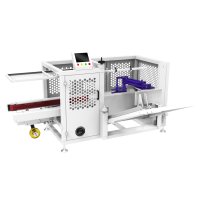
A box forming machine is a purpose-built piece of equipment designed to do one job at high speed. An operator feeds flat cardboard blanks into the machine one by one. The machine folds the box automatically, forms the bottom flaps, tapes the base, and outputs a finished box ready for product loading.
Machines in this category handle box lengths from 145mm up to 650mm. Production speed ranges from 5 boxes per minute for larger box sizes up to 30 boxes per minute for smaller ones. Power consumption runs at approximately 2 to 2.5 kilowatts on standard 220 volt single phase supply, which means no special electrical infrastructure is required in most Malaysian factories.
The footprint is compact. Most models fit into an existing production floor layout without significant reconfiguration. There is no programming requirement and no specialist knowledge needed to operate the machine.
The SKU Changeover Limitation
When you switch to a different box size, the machine requires manual adjustment. On a basic manual adjustment model, this changeover takes time and introduces the risk of operator error. If the settings are not dialled in correctly after a changeover, the first batch of boxes will be inconsistent or rejected.
A servo motor version of the machine reduces this risk significantly. The changeover is faster, more repeatable, and less dependent on the skill of the individual operator. The servo model costs more, but for operations that switch box sizes regularly, the additional investment is justified by the reduction in downtime and waste.
How the Cobot Box Forming System Works
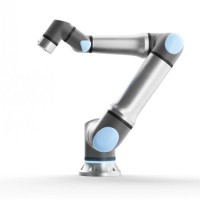
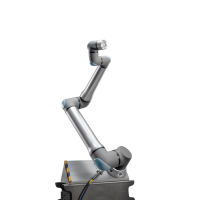
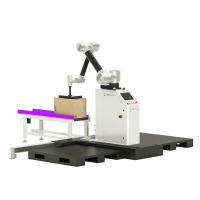
A cobot box forming system uses a collaborative robot arm fitted with a custom gripper to perform the same box erection task. The cobot picks up a flat cardboard blank from a mechanical feeder, slides it into a folding mechanism that forms the bottom flaps, tapes the base, and places the finished box onto a conveyor for the next process.
Unlike the box forming machine, there is no standard off-the-shelf cobot box forming system you can order directly. Every cobot box forming installation is a custom-engineered solution. A basic system using a compact cobot arm starts at USD 40,000 to 50,000 for the complete integrated system. Cost increases as you add more feeders, extend the arm reach, or add features.
Where the Cobot Wins
A cobot configuration with multiple flat box feeders, each loaded with a different box size, can switch between box sizes without any manual adjustment or line stoppage. The cobot selects the appropriate box size from the relevant feeder based on the production schedule.
As long as the dimensional differences between box sizes are not too large, one cobot system handles the full range. No changeover time. No operator intervention. No risk of incorrect manual adjustment.
The tradeoff is cycle speed. The cobot is slower than a dedicated box forming machine. It is designed for flexibility, not maximum throughput.
Side by Side Comparison
| Factor | Box Forming Machine | Cobot Box Forming System |
|---|---|---|
| Investment cost | From USD 10,000 | From USD 40,000 to 50,000 |
| Cycle speed | 5 to 30 boxes per minute | Slower than machine, varies by configuration |
| SKU flexibility | Manual adjustment required when changing box size | Handles multiple box sizes without stopping, within limits |
| Labour to operate | One operator to feed flat cardboard | One operator to feed flat cardboard |
| Setup complexity | Plug and run, minimal programming | Fully custom built, requires integration and commissioning |
| Best for | High volume, single or low SKU operations | Multi-SKU operations where changeover time matters |
⚠ A Hidden Cost Both Systems Share
Both systems require consistent cardboard quality to perform reliably. If your flat cardboard blanks have inconsistent dimensions, come from a low quality supplier, or vary significantly in thickness or stiffness, both the machine and the cobot will struggle. Misfeeds, jams, and folding errors increase.
Malaysian and Southeast Asian manufacturers sourcing cardboard locally need to evaluate their supplier quality before installing either system. Upgrading your cardboard supplier may be a prerequisite, not an optional extra.
For cobot systems using suction cup grippers, dusty cardboard creates an additional maintenance issue. Cardboard dust accumulates on suction surfaces over time and reduces grip reliability. Regular cleaning is required to maintain consistent pick performance.
Which Industries in Malaysia Are Automating Box Forming
Based on current market activity in Malaysia, the industries investing most actively in box forming automation are:
 Catalog
 Catalog
 Catalog
 Catalog

Leave a Comment