-
Your shopping cart is empty!

Your shopping cart is empty!
Physical AI, the class of models that let robots see, feel, and act in the real world, is only as good as the data it learns from. Most of that data still comes from lab rigs that look nothing like a real factory floor, which is one reason so many promising robotics models struggle the moment they leave the lab. Universal Robots recently introduced the UR AI Trainer, a data collection system built on production grade cobots, to close that gap. FA Controls Sdn Bhd sees a bigger opportunity in this technology than a single product sale. With the right setup, Malaysian universities could host this rig, train their own students on it, and generate real revenue by supplying validated robot demonstration data to industry.
"FA Controls welcomes collaboration with Malaysian universities on this front. Our team is motivated to put the knowledge we have built over the years to work for the nation, through the adoption of transformative technology, with a mission to prepare the next generation, our society, and Malaysian companies to weather this transformation."
Ir. Ts. Jacky Lim
General Manager, FA Controls Sdn Bhd
The system pairs two robot arms working together instead of one. A human operator guides a leader arm through a task using an ergonomic teaching handle, and a follower arm mirrors the motion in real time. Force feedback runs at roughly 2 milliseconds of latency, low enough that the operator can feel real contact, which matters for tasks like assembly and insertion that are hard to teach any other way.
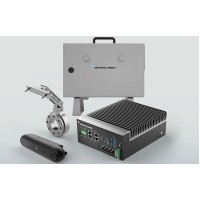
While the demonstration happens, four synchronized camera streams record alongside joint states, force and torque readings, and IMU data, all on the same clock. Software from Scale AI turns each recording into a structured, validated dataset that is ready for training Vision Language Action models, the category of AI models that combine vision, language, and physical action. The hardware itself uses UR3e leader arms, UR7e follower arms, Robotiq grippers, and an on system AI Accelerator built on NVIDIA Jetson Orin compute, all mounted on an industrial platform developed with Vention.
In plain terms, it is a purpose built rig for recording how a task should actually be done, with enough precision and synchronization that the data can train a model instead of only informing a human operator.
Two short clips make this easier to picture than any description. The first shows an operator guiding the leader arm through a real task. The second shows what a robot can do once it has been trained on data captured this way.
Video 1: An operator demonstrating a task on the UR AI Trainer leader arm
Video 2: An example of a trained robot performing an automotive kitting task on its own
Malaysia has spent the last two years putting real money behind AI and robotics. The National AI Action Plan 2026 to 2030, coordinated by the National AI Office, sets a goal of placing Malaysia among the top 20 countries globally for AI readiness by 2030. Reported allocations under this push include a National AI Innovation Fund of roughly RM2 billion, offering grants between RM50,000 and RM5 million per project, and AI Research Excellence Grants totalling around RM1.5 billion, offering between RM100,000 and RM10 million per research project.
Robotics has its own dedicated track. The National Technology and Innovation Sandbox, run by MRANTI together with MTDC with an allocation of about RM100 million, includes Robotics and Automation and Artificial Intelligence among its sandbox sites, and already connects with research universities such as Universiti Malaya, Universiti Teknologi PETRONAS, Universiti Sains Malaysia, Universiti Teknologi MARA, and Multimedia University. Malaysia also has a National Robotics Roadmap running through 2030 that predates all of this, showing the ambition here is not new.
What is missing is not funding or ambition. It is production grade infrastructure that can actually generate the kind of real world, industrial data these funded research programmes are meant to produce. A rig like the UR AI Trainer, sitting inside a university engineering faculty, is exactly the kind of asset these schemes were designed to support.
Here is where the monetisation angle comes in. A university engineering faculty could host a UR AI Trainer as its imitation learning laboratory, with postgraduate students and research staff operating the rig and producing validated datasets as part of their coursework and research output.
Instead of that data only feeding internal papers, the faculty could offer it as a service. Manufacturers, robotics startups, and AI teams that need real, industrial grade demonstration data, but do not want to buy and operate their own rig, could commission recording sessions through the university. This could take a few forms:
This model already exists in various forms for other kinds of applied robotics research abroad. What makes it interesting for Malaysia now is the timing. A funded pilot at one engineering faculty, supported through a National AI Innovation Fund grant or the National Technology and Innovation Sandbox, could establish the operating model, prove the revenue case, and become a template other universities replicate.
FA Controls Sdn Bhd has represented Universal Robots and the wider Teradyne Robotics portfolio in Malaysia since 1989. For a university exploring this idea, our role is to help scope what hosting a UR AI Trainer would actually involve, from understanding which funding scheme fits the project, to setting up the leader follower rig, to training the first cohort of student operators.
The UR AI Trainer is a newly introduced system and is not yet generally available for sale in Malaysia. At this stage, the conversation is about scoping interest and preparing a proposal, not placing an order. If your faculty is already thinking about a Physical AI or robotics research programme, this is a good time to start that conversation early.
Physical AI in Malaysia will not mature by importing finished models alone. It will mature by capturing our own industrial data, on our own production hardware, close to the people who will use it. If your university is exploring what a Physical AI research and training programme could look like, we would like to talk.
Email FA ControlsMalaysia funding figures referenced above are drawn from public reporting on the National AI Action Plan 2026 to 2030, National AI Innovation Fund, AI Research Excellence Grants, and the National Technology and Innovation Sandbox. Figures are subject to change as these programmes are implemented, and interested universities should confirm current terms directly with the relevant agency before applying.
 Catalog

Leave a Comment